
 EN
EN  ES
ES Spain cannot continue to grow in tourism by volume alone. That stage is over. What is coming now is something else: a more conscious tourism, more digital, more connected to people and territories. That is the idea behind the Spain Tourism Strategy 2030, The roadmap with which the government wants to guide the transformation of the sector during this decade. Behind the document there are more than two years of work, consultations with the entire tourism ecosystem and a clear vision: to turn Spain into the world's most important tourist destination. world reference for sustainable tourism.
But - and here comes the key - no strategy will work if we don't know how to communicate it, make it credible and turn it into action.. And that is marketing. Not marketing in the sense of “advertising”, but in the broader, more strategic sense: understanding the market, connecting with people, measuring impact and building long-term brand equity.
The future of Spanish tourism will depend as much on technology and sustainability as it will on how we know how to count them.
What is Spain Tourism 2030 (and why does it affect us all)?
The Spain Tourism 2030 Strategy proposes a comprehensive vision of the sector. It is not only about attracting visitors, but also about ensuring that tourism generates wellbeing, preserves the environment and remains competitive in an increasingly demanding global context.
Its pillars are clear:
- Environmental, social and economic sustainability.
- Digitization and data intelligence.
- Quality, training and decent employment.
- Collaborative governance.
- Territorial and cultural cohesion.
Based on these principles, the plan is articulated as follows 5 programs, 20 objectives and 148 actions, The goals are to reduce the carbon footprint of tourism, professionalize the sector, strengthen Spain's international reputation and digitize the business fabric.
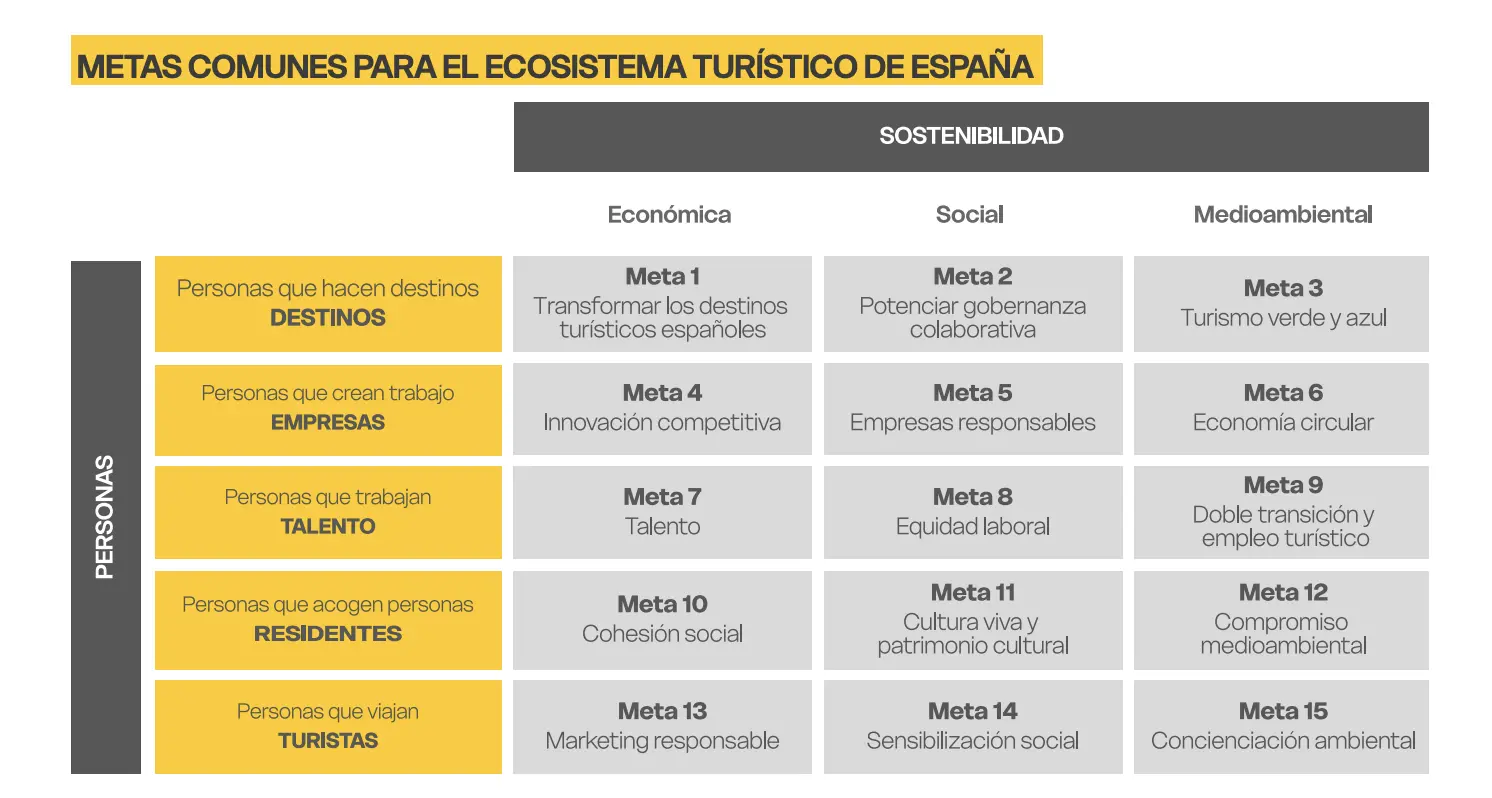
In theory, perfect. But in practice, the change will depend on how companies - hotels, agencies, destinations, restaurants, golf courses, etc. - decide to change. interpret these values and integrate them into their daily lives..
And that's where marketing becomes a transformative tool.
From plan to action: when marketing makes big goals tangible
From sustainability to storytelling
The sustainability is no longer a seal on the website or a section in the CSR report.
It is a story that must be have authenticityWho you are, how you care for your environment, what impact you have. Travelers want to know, and destinations that don't communicate this will be left out of the conversation.
A hotel that uses renewable energy and collaborates with local producers is not only reducing emissions: is building a narrative that connects with a new type of traveler., more demanding and emotional. Telling it well, with data and emotion, is part of the new tourism marketing strategy.
2. From digitization to data
The Spain Tourism 2030 Strategy highlights digitalization as a key to competitiveness. But digitizing is not just about having a website or publishing on networks: it is about using data to make decisions.
Marketing plays a decisive role here. Business intelligence (BI) tools, dashboards, online reputation analysis, campaign automation or predictive segmentation enable hotels and destinations to to better understand your customers and anticipate their behavior.
At weglobeyou we see it every day: a hotel that knows which markets book it first, which services it values most and which content generates the most interaction. you can adjust prices, messages and offers in real time, with measurable results in terms of occupancy and profitability.

3. From collaboration to community
Tourism is not an isolated industry, but an ecosystem.
Strategy 2030 speaks of “shared governance,” but in marketing terms that translates into. creating communitiesdestinations that communicate with their hotels, hotels that promote their local producers, groups that join forces with technological or cultural partners.
This collaborative approach not only amplifies messages, but also generates reputation and trust, two essential assets in any current tourism strategy.
4. From experience to loyalty
Another of the major changes proposed in the plan is to move from the transactional tourist to the relational traveler.
Marketing should stop focusing solely on attracting visitors and instead focus on create experiences that build loyaltyPersonalization, in-stay and post-trip communication, loyalty programs and useful content throughout the entire cycle.
A visitor who feels listened to and valued not only repeats, but also recommends. And there, the connection between marketing, data and service makes the difference.
The five programs of the plan, translated into marketing language
- Sustainability and territorial balance: Turn sustainability into competitive advantage. Communicate local values, heritage and authenticity. Promote less crowded destinations through emotional content and territorial branding.
- Digital transformation and tourism intelligence: Incorporate BI, AI and CRM to centralize data and measure results. Automate tasks, segment audiences and personalize messages. Move from reactive marketing to predictive marketing.
- Competitiveness and business resilience: Position brands with purpose, coherence and differentiation. Focus on branding, reputation and direct profitability. Avoid relying solely on intermediaries and strengthen direct sales.
- Talent, training and quality employment: Communicate the human value of tourism. Build attractive employer branding. Train teams in new digital, sustainable and communicative skills.
- Governance and cooperation: Promote public-private collaboration and co-marketing between administrations, destinations and companies. Create joint strategies and aligned messages that strengthen the positioning of Spain as a sustainable destination.
How tourism marketing can accelerate Spain Tourism 2030
At weglobeyou we have worked with more than 200 hotels, golf courses, restaurants and destinations in Spain, Portugal, Andorra and Latin America.
And we know that The objectives of Strategy 2030 will only be achieved if companies in the sector incorporate marketing as part of their strategic management, not as an add-on.
- Because sustainability needs communication. If it's not counted, it doesn't exist. But if it is miscommunicated, it becomes greenwashing.
- Because digitization needs purpose. It is not a matter of having data, but of knowing how to interpret them in order to make human decisions.
- Because profitability depends on consistency. Hotels with a clear brand, strong reputation and integrated digital strategy. are the ones that achieve higher direct sales and better margins.
And this is not theory.
We have seen this in cases such as Hotel Leman (Mallorca), which went from 1 % to 32 % of direct sales in two years after renewing its website, SEO and pricing strategy. Or the Hotel Casa Lorenzo, which reached 85 % of direct bookings thanks to a joint communication and loyalty strategy.
These are real stories that show how marketing is the engine that turns the big goals - sustainability, digitization, cohesion - into results.
The role of agencies in this new stage
The Spain Tourism 2030 Strategy sets the framework. But the specialized agencies, such as weglobeyou, are those who can translate that vision into measurable actions:
- Supporting companies in their digital transformation.
- Developing strategies for branding and positioning consistent with the values of sustainability and authenticity.
- Implementing communication campaigns, SEO, social media and online reputation aligned with the goals of the plan.
- Training teams and industry professionals to integrate responsible marketing as part of their corporate culture.
Because, in the end, sustainability is not achieved with solar panels or technology alone: it is achieved with a well-told story and consistent branding.
The future of tourism will be written with marketing
The Spain Tourism 2030 Strategy is a unique opportunity to redefine our tourism model. And marketing -understood as strategy, analysis and creativity- will be the bridge between the major institutional objectives and the daily actions of each company.
If Spanish tourism wants to continue to be a leader, it must communicating with purpose, measuring with intelligence and acting with consistency. That is the real challenge of the next decade.
We believe that sustainable tourism is not only built, is communicated. And that marketing is the common language that will unite sustainability, profitability and reputation.
At weglobeyou we help hotels, destinations and tourism groups transform their marketing strategies to align them with the objectives of Spain Tourism 2030. If you want to turn sustainability and digitalization into results, let's talk.