
 EN
EN  ES
ES In Mallorca everything is decided just a few meters from the sea. In Playa de Palma, where decades of hotel tradition coexist with an increasingly digital present, competing is not only about filling rooms, but also about choosing who brings guests and under what conditions. This case of success in tourism marketing account the transformation of the Hotel Lemana four-star restaurant with a family soul that decided to regain control of its distribution and turn its website into the real heart of the business. There are no fireworks or grandiloquent promises here. There is context, decisions and verifiable results.
Who is Hotel Leman
The Hotel & Apartments Leman opened its doors in 1967 and, since then, has grown through reforms, criteria and a way of working that balances Mediterranean style with modern comfort. It is on the second line of Playa de Palma, less than two hundred meters from the sand and just ten minutes from the airport of Son Sant Joan. This location allows for what so many families and couples who come to the island are looking for: to walk down to the beach, return to the pool at sunset and, when the mood strikes, take public transport to the Cathedral, the old town or Bellver Castle.
The establishment combines rooms, a suite and bright tourist apartments, with terraces overlooking the Mediterranean or the gardens. The experience is completed with an outdoor swimming pool and solarium, a heated indoor pool integrated in the wellness area, sauna, massage service and gym. The gastronomy is articulated around a Mediterranean-inspired buffet restaurant, an indoor bar for the afternoon and evening and a pool bar for those who do not want to leave the water at noon.
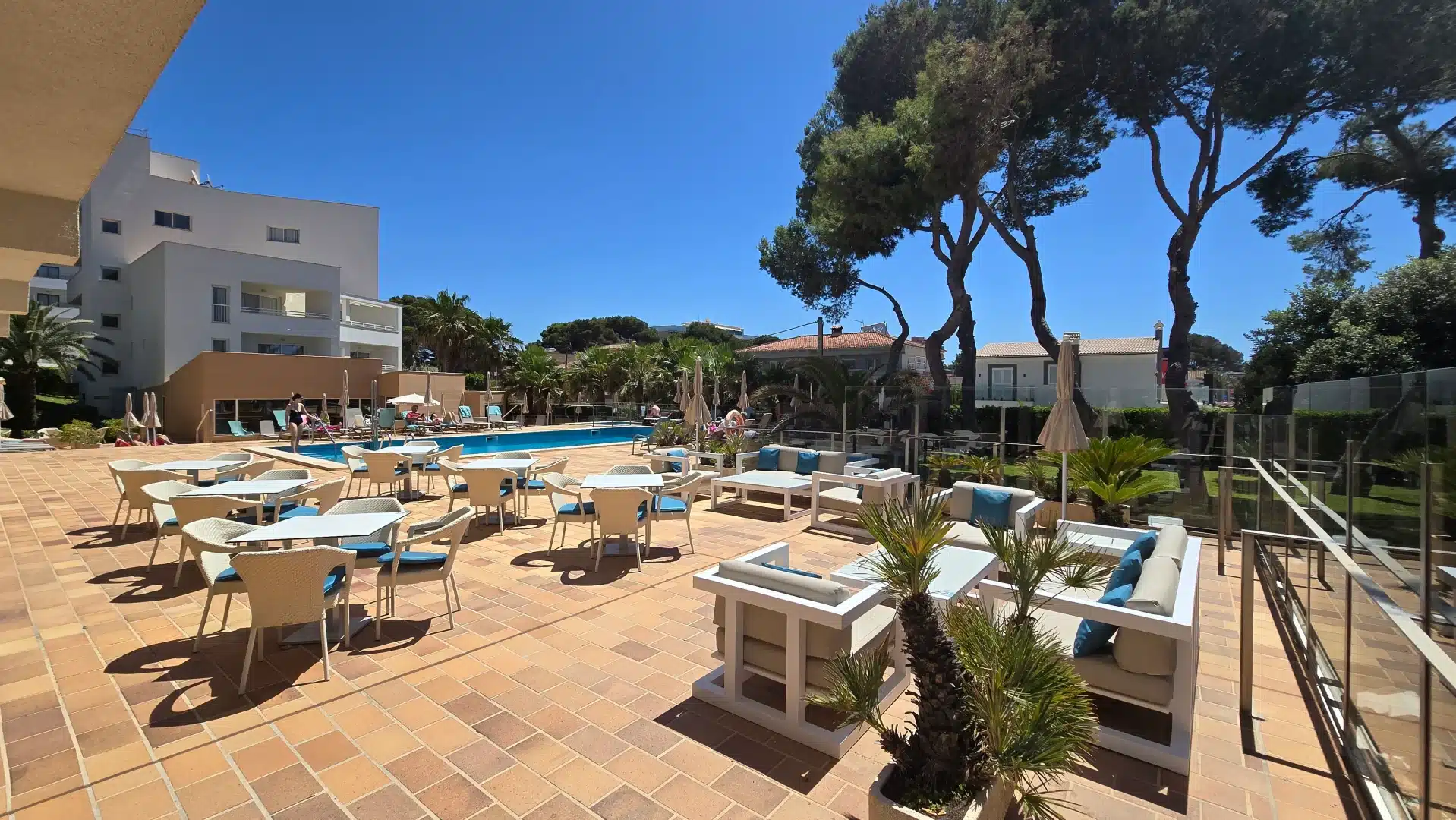
For travelers arriving with their bicycles in tow, the Hotel Leman is a serious base camp: garage for up to 150 bikes, washing area and a small workshop that facilitates maintenance before going out to ride around the island. All this maintains the tone of a family hotel that values the treatment and repetition of the client over the artifice.
There is another defining feature of the Hotel Leman and that explains its fit with the contemporary traveler: its understanding of sustainability as a sum of small, constant decisions. The hotel's circularity plan reduces water and energy consumption through LED lighting, faucet aerators and dual-flush toilets; progressively eliminates single-use plastics; opts for local suppliers in the kitchen; and invites guests to opt for more rational linen and towel changes.
Sustainability also extends to the equipment: with European NextGeneration funds, bed lifts have been installed in the rooms to improve the ergonomics of the housekeeping staff and reduce the risk of injury. The idea is simple and effective: customer well-being, employee well-being and respect for the environment are all part of the same project.
The challenge
For years, like so many other hotels on the island, the Hotel Leman relied on the classic intermediation model to attract them. Occupancy came, but commercial autonomy was limited and margins were fragile. In May 2021, the data that set us in motion was unequivocal: only 0.5 % of sales were direct sales.. The hotel management and our team agreed on the diagnosis and on the horizon: it was necessary to reduce dependence on tour operators and build a profitable, scalable direct channel with a long-term vision. The way forward was not to abandon intermediaries, but to rebalance the mix and place the official website at the center of the customer relationship.
The challenge, therefore, was not to "be more visible", but to sustain a continuous flow of direct bookings and turn that visibility into business. It had to be done, moreover, in one of the most competitive scenarios in the Mediterranean, where the traveler decides from his cell phone and expects everything to work as smoothly as if he were booking a flight or a rental car.
How we did it
The project was articulated as what it is: an integral strategy of tourism marketing that acts at all stages of the customer journey and at all points of contact between the hotel and the customer. Digital advertising was the driving force. We worked on Google Ads and Social Ads campaigns with a full-funnel approach, segmented by markets of origin and language, and fine-tuned according to the time of the trip.
The logic was clear: reach the inspiration with pieces that tell the product well, be present in the consideration with messages of value from the direct channel and close the decision with creatives and landings that reduce friction. This advertising did not operate blindly. We measured, compared and remeasured to sustain a low acquisition cost and honest attribution.
The website stopped being a showcase and started behaving like a sales center. We redesigned the navigation so that finding what was important did not require learning how to use the site. The discourse was tidied up: who you are, where you are, what you offer and why book directly. Clean messages were incorporated about best rate guaranteed, flexibility y exclusive advantages for the proprietary channel. The booking engine gained speed, clarity and confidence. The objective was for the customer to perceive that, on the official website, everything is understood the first time and is closed smoothly.
In parallel, we work on the Technical and local SEO so that visibility would not depend solely on investment. Optimizing structure, loading times and interlinking was non-negotiable; the same as ordering the presence of the Hotel Leman on Google Maps and other platforms with consistent data and photographs that show the reality of the product. The content strategy was adapted to the main markets, with messages and nuances that speak in the language -literal and symbolic- of those seeking sun, relaxation, wellness or cycling in Mallorca.
Technology was the mortar that allowed everything to work together. Booking engine and channel manager synchronized for availability and rates in real time; correct labeling so that each source was well identified; basic automations in CRM to prepare the stay, accompany it and close it with intelligence. Nothing ostentatious, nothing free: just pieces that connect so that the system responds without noise and the data is useful when making decisions.
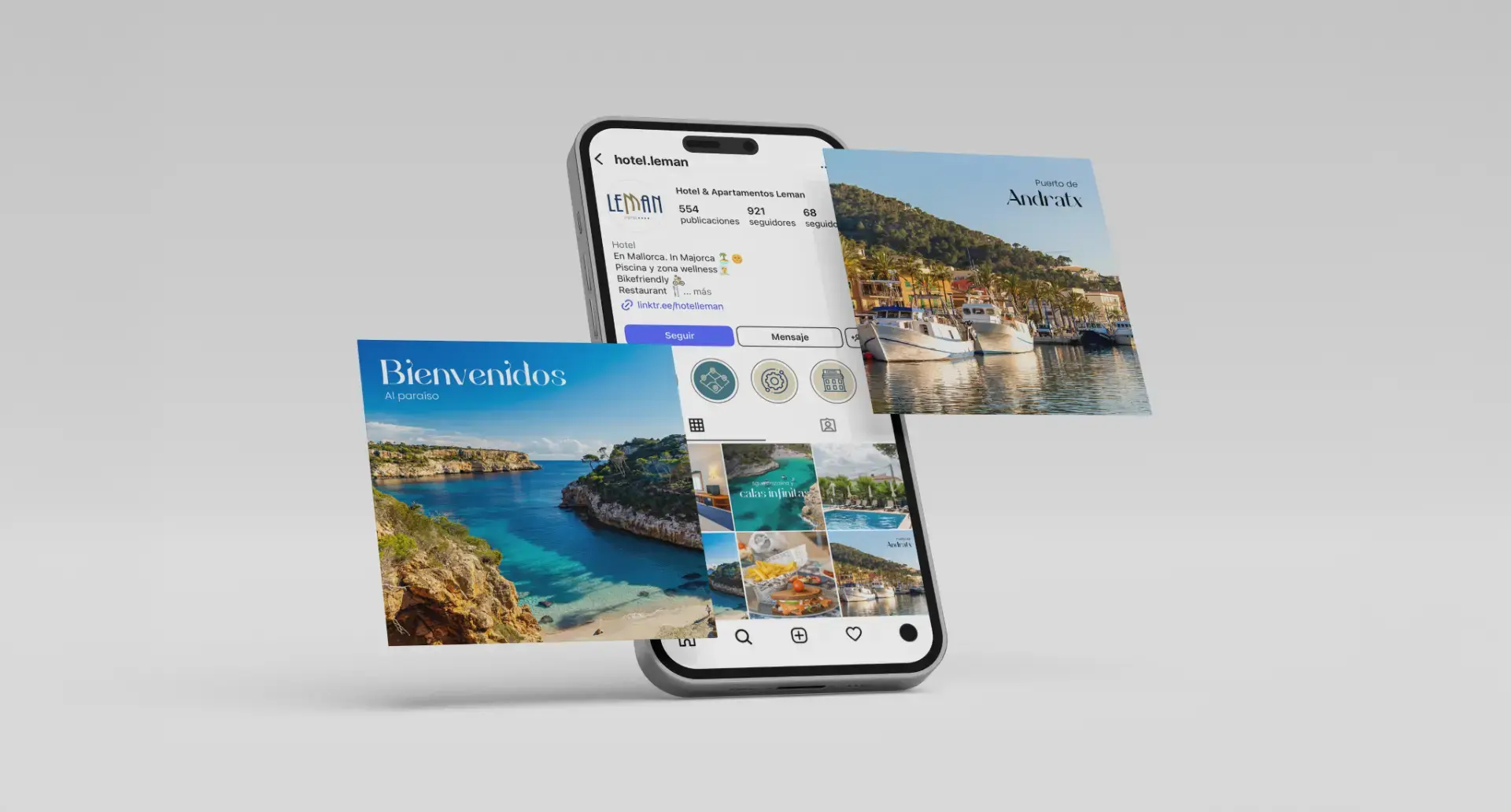
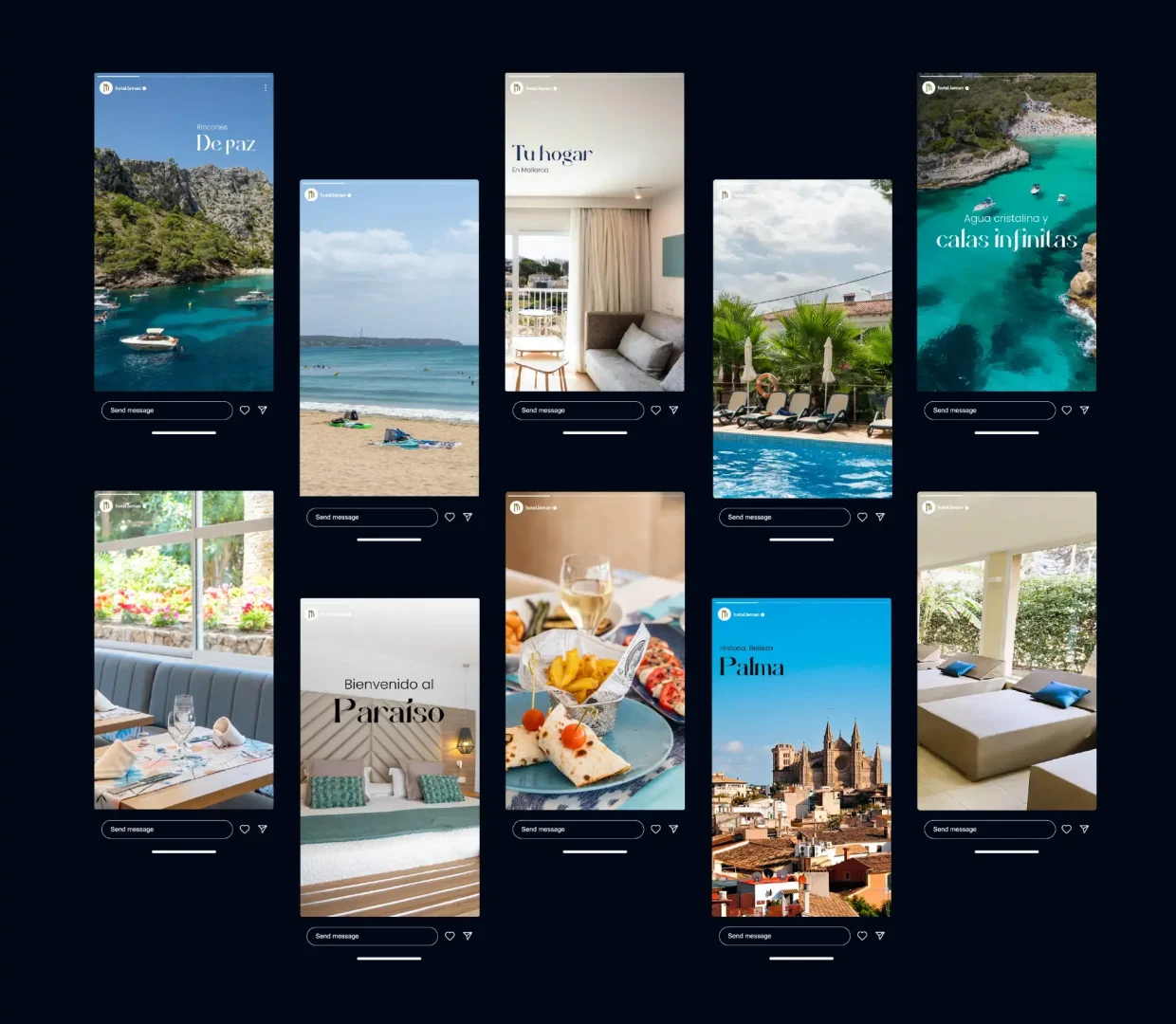
The social networks completed the picture with a dual role. On the one hand, they reinforced the natural positioning of the hotel with an editorial line in line with its identity, which shows the real rhythm of the Hotel Leman and their environment without imposture. On the other hand, they became a tactical reinforcement for recruitment and remarketing, directing the user to a website capable of converting. Social proof - user reviews and content - helped close the circle of trust that every traveler seeks before paying.
None of this would have worked without an element that is rarely mentioned in the results pages: coordination with the hotel's own team. Training, alignment and consistency. The promises made by a campaign must be kept at the front desk, in the restaurant and in the cleanliness of a room. This contrast, when it exists, multiplies. When it does not, it penalizes.
Results
The results make it possible to speak clearly. The total investment in ADS campaigns stood at 18.638,26 € and the direct sales generated through the website reached 721.252,95 €. The ROAS was 38.7This represents almost thirty-nine euros in sales for every euro invested. The acquisition cost remained at 2,58 %a figure that confirms the efficiency of the system. In terms of distribution, the direct channel came to represent the 23 % of reserves in 2023 and reached 32.5 % in 2024 as of the closing date of the case.
Beyond the isolated number, the important data is the direction of the curve. The Hotel Leman consolidated its official website as the main sales channelwhich translates into better margins, major loyalty capacity and a own database on which to work in the future. In a context as demanding as Playa de Palma, this evolution is not a miracle: it is the result of aligning product, technology and communication so that everyone is rowing in the same direction.
What remains
A project of tourism marketing is not only measured by its initial sparkle, but by its ability to sustain itself. In the Hotel LemanThe learning is straightforward: campaigns work when the web converts; the web converts when the message is clear and the process is fast; the process is fast when the technology is well connected; and all of the above makes sense when the hotel operation delivers what it promises. The rest is noise.
The case also leaves a useful certainty for hotels in mature destinations: it is possible to compete. It's not a matter of giving up intermediaries, but rather of regain autonomy and decide which part of the business needs its own channel to make the project healthier, more predictable and more profitable.
A lesson for the industry
The case of success in tourism marketing from Hotel Leman shows that direct selling is not a romantic yearning or a passing fad, but a strategic decision that changes margins, relationships and the future. From 0.5 % in 2021 to 32.5 % in 2024, with an ROAS of 38.7 and a CAC of 2.58 %, the path speaks for itself.
At weglobeyou we have accompanied this process with a comprehensive and measurable strategy. And most importantly, the results are real, sustainable and replicable.
If your hotel wants to make the same leap, we speak clearly: there are no magic formulas, but there is a method, perseverance and a team that knows how to do it. Contact with us and we will design together a tourism marketing plan that will turn your direct channel into the heart of your business.