
 EN
EN  ES
ES Digital marketing for hotels is no longer about being on the Internet. It's about survive gracefully in an ecosystem where everyone says the same thing and only a few get travelers to remember them. The hotels that grow are not the ones that “campaign”, but the ones that understand the digital business as an extension of their strategy.
And yes, that's where we live: on the border between data and emotion, between profitability and brand.
Because a hotel can be full and not profitable. It can have followers and not have authority. It can invest in ADS and still depend on OTAs.
Hotel digital marketing - done well - is not about doing more things, but about with intention, method and vision..
Lhe age of data (and emotion)
A few years ago, it was enough to have a decent website and appear on Booking. Today, 70 % of Spanish hotels recognize that their future profitability will depend directly on their digital maturity (Digitization Study of the Hospitality Industry 2024). Data is at the heart of everything, but if data doesn't tell a story, it doesn't sell.
The traveler is no longer looking for a place to sleep; he looks for a brand you can trust. And that trust is built with digital consistency: a website that inspires, SEO that ranks on its own merits, advertising that doesn't shout and a community that doesn't rent. Everything else is fireworks.

The web: where it all begins (and is measured)
If your website doesn't sell, you have no direct channel. It's as simple as that.
The hotel website is much more than a catalog of rooms; it is the only space where you have absolute control over what the traveler sees, feels and decides. Every detail matters: the structure, the speed, the images, the tone, the booking engine. Most hotel websites die before the click “Book” because speak to the guest as if he/she were a file, not a person..
A well thought out website not only attracts traffic, it converts it. And not with discounts, but with trust. With storytelling, with copy that smells like a destination and with messages that reinforce the idea that booking direct makes sense.
That's the difference between filling rooms and building brand.
SEO: the art of showing up when it matters
Hotel SEO is not a technical trick, it is a long-term visibility strategy.
Hotels that rank well don't do so by luck: they do it because they have understood your customer's search intent. When someone types “charming hotel in Cadiz”, they are not looking for an algorithm; they are looking for a promise. And Google rewards those who respond best, not those who repeat the most keywords.
Well-crafted SEO mixes content, reputation and user experience. A fast website, a useful blog (not filler), updated Google listings and a solid local presence are worth more than any black hat trick. And, according to Hotel SEO Report 2025 from Good Rebels, hotels with an active local content strategy generate 22 % more map clicks and 18 % more organic traffic.
Digital marketing for hotels finds its strongest starting point here: organic positioning that attracts the right guests, at the right time, and without relying on intermediaries.
SEO is not free. It is a slow-burning investment, but its return is the most honest: qualified visits and commission-free bookings.
Digital advertising: invest well, don't spend more
Google Ads, Meta, TikTok, Hotel Ads... The platforms change, but the principle remains the same: if you don't know who you're talking to, you're throwing money away. An ad doesn't sell by being pretty, it sells by being relevant.
Good digital advertising combines data, targeting and creativity. It's not about appearing everywhere, it's about to appear where the traveler is about to decide. And yes, Google Hotel Ads is the most profitable battlefield when managed with strategy: showing your direct price next to OTAs not only increases bookings, it also changes the perception of your brand.
In the latest studies of Amadeus y D-EDGE, hotels that combine metasearch, remarketing and display campaigns have improved their average ADR by up to 57 %. The trick is to measure everything: CPA, ROAS, net margin. If you don't know how much a direct booking costs you, your marketing is not digital, it's decorative.
The real power of digital marketing for hotels lies in its ability to connect every click with a tangible result: more bookings, a better reputation and a brand that leaves its mark.
Social networks: from showcase to conversation
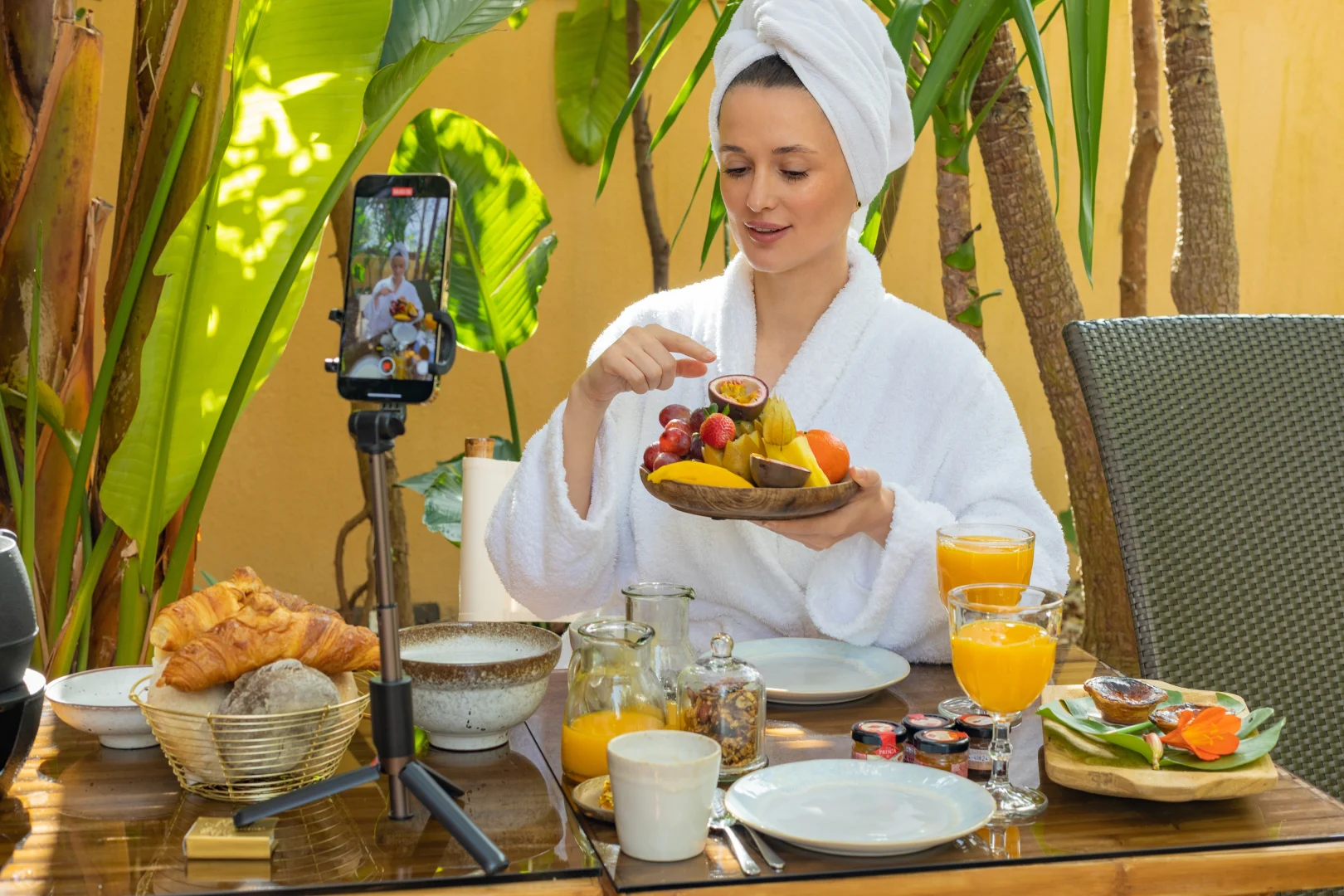
Social networks stopped being a photo gallery some time ago. Today they are the place where your brand is humanized or lost. It is not enough to show the sunrise from the pool. You have to tell why that sunrise matters, what is the story behind it, who is on the other side of the counter.
Instagram remains the best showcase to inspire, TikTok the most powerful tool for reaching young audiences, and LinkedIn the ideal space to build B2B authority. But the network doesn't matter as much as consistency: your tone, your messages and your frequency say more about your brand than any reel.
The hotel brands that perform best in networks are not the ones that publish the most, but the ones that understand the balance between emotion and strategy. When a brand combines content that connects with people with data-driven decisions, what everyone is looking for happens: more real interaction, more traffic to the web and more direct bookings. The key is not to be viral, but to be relevant. In telling something that has soul... And a metric behind it.
Email marketing and automation: the channel that never fails
In a world of volatile algorithms, email is still home turf. Every guest who leaves you their email is saying, “we'll talk, you and me, no middleman.” The problem is that most hotels don't know what to tell you.
The hotel email marketing works when understands the guest's journey. Before you arrive, it is a welcome. During your stay, an invitation to discover more. Afterwards, a conversation that doesn't end with check-out.
Automation multiplies the impact and reduces the operational burden: personalized messages according to language, booking channel or date of stay, all integrated with your CRM or PMS. The figures don't lie: the average ROI of email marketing in the hotel industry exceeds €35 for every euro invested. And best of all, no algorithm can take it away from you.
Online reputation: the new sales floor
More than 80 % of travelers read reviews before booking. And a single negative review, poorly managed, can cost you dozens of empty nights. Online reputation is not improvised: it is managed with method, empathy and consistency.
Responding is not enough. You have to read between the lines.
Sentiment analysis - that jewel that artificial intelligence is polishing at full speed - is no longer the stuff of laboratories. Today, it allows hotels to detect patterns in feedback, anticipate problems and turn a complaint into an opportunity for improvement. When digital listening is combined with AI tools, reputation ceases to be reactive and becomes strategic. In a few months, hotels that work with real data, not intuition, achieve a tangible improvement in their online perception.
Because every opinion is an opportunity to reinforce trust and brand narrative. If the reputation is good, the price becomes secondary.
Artificial intelligence: from marketing to predictive performance
AI has not come to replace marketing teams; it has come to make them more dangerous. Hotels already using it are not only saving time, but are also make better decisions. AI analyzes, predicts and automates what was once intuition.
Chatbots capable of closing bookings, recommendation engines that adjust prices in real time, dynamic segmentation based on behavior... According to the Amadeus report, 98 % of European hoteliers plan to invest in AI applied to marketing and revenue. The question is no longer whether to use it, but whether to use it. how much sooner you are going to do it.
The challenge is not in the tool, but in the strategy. Without purpose, AI is just software. With purpose, it is the most powerful competitive advantage in the industry.
Digital independence: the hotelier's new luxury
For years, OTAs dominated the game. Booking, Expedia and company set the rules and the margins.
But that is changing. The Digital Markets Act and the investigation open to large platforms have opened a door: the era of digital independence.
Each direct booking represents between 15 % and 25 % more net profit. It's not about breaking up with the OTAs, but about rebalancing the relationship. And that can only be achieved with its own brand, a coherent digital strategy and data control.
Digital marketing for hotels is the tool that gives power back to the hotelier: it creates visibility, generates community, builds guest loyalty and builds value. Digital is not the end, it is the means to regain independence.
Trends 2025-2026: what's changing the game
Digital marketing for hotels is undergoing a silent transformation. What was once innovation is now standard. What seems novel today will be mandatory tomorrow.
Five forces are currently redrawing the map:
- extreme customization;
- audiovisual content;
- omnichannel;
- sustainability; and
- ethical data management.
But beyond fashions, there is a clear direction: marketing ceases to be communication to become an experience. Travelers no longer distinguish between what they see on screen and what they experience at the destination. And therein lies the opportunity: to integrate brand, technology and purpose into the same story.
Spain's Tourism Strategy 2030: the future is already here
Meanwhile, Spain is preparing for the sector's biggest strategic leap in decades. The Spain Tourism Strategy 2030 is much more than an institutional document: it is a declaration of intent. It proposes a more sustainable, more digital and more competitive tourism model, where hotels are key players in the change.
It talks about shared governance, technological innovation, data management and territorial balance. And, although it sounds political, it actually talks about digital marketing for hotels and tourism companies: how to better tell who we are, how to use technology to create more human experiences, and how to make profitability and responsibility go hand in hand.
Hotels that integrate this vision - that measure their footprint, digitize processes and communicate transparently - will not only meet targets. They will lead the new Spanish tourism.
How to activate your strategy (and not die trying)
Talking about strategy is easy. Activating it, not so much. Most hotels stay at the “we're working on it” stage. But digital marketing for hotels only makes sense when it becomes measurable action.
It all starts with a realistic diagnosis: know where you are, what channels work, what your distribution mix is and how your guests behave. Then, build a roadmap that combines SEO, content, networks, ADS and automation. And finally, measure. Without analytics, there is no improvement. No improvement, no strategy.
Digital marketing is not a sprint: it is a process of continuous adaptation. Measure, learn and adjust. Or, as we say here, think with data, create with head and execute with soul.

The future belongs to hotels with strategy
Hotel digital marketing is no longer just a tool to sell, but a way of designing the future of hospitality. Hotels that understand that their communication, technology and reputation are part of the same story will lead the next decade.
At weglobeyou We have been working with them for years: creating strategies that multiply brand value, transforming visibility into sales and helping hotels to stop depending on third parties and become owners of their own destination.
Because tourism marketing is not about shouting louder. It's about having something to say and saying it with meaning.
Is your digital marketing up to par with your hotel?
If you are not sure, we can help you to see it. with data, strategy and a vision that connects business and brand. Let's talk about how to make your direct channel yours again.